Official Rulebook
Last updated December 11, 2025
Section I – Membership
1.1 Membership Requirements
Ranch Sorting National Championship Memberships that are purchased on April 1 or after, by non-current members, are valid until June 30 of the following year. Members are only allowed to hold & purchase 1 current membership for a season. Members can upgrade their membership at any time throughout the season. To find out more about the benefits of becoming an RSNC member, view our website at RSNC.us.
Participation at a Cinch RSNC event requires being a member of the Cinch RSNC to collect winnings. Before participating, if a sorter is not a current member, he/she can submit a membership application to the National Office, purchase the membership onsite at any sanctioned event, or purchase the membership online at RSNC.us. Sorters will be permitted to purchase or renew memberships anytime during the year; that membership is valid from the time of purchase until June 30th. If a non-current member purchases a membership in April or May it will be valid through June 30th of the following year. Memberships can be upgraded anytime throughout the year but are only good for the current season. While a sorter can participate in regular classes at RSNC events, the Gold Shootout classes are limited to Gold & Platinum members only. Platinum members will pay a discounted entry fee in all Gold Shootout classes offered by the Cinch RSNC. Membership Day passes will be available and can be used at RSNC events on a 1 show per weekend basis. Participation in a RSNC event by a sorter who does not have a current membership or has not submitted a renewal membership application as specified, will result in disqualification of the sorter and the sorter’s teammate. By entering a RSNC event, the sorter represents that he/she is in compliance with the membership requirements. Acceptance of an entry at an event by RSNC or its producers shall not constitute a waiver of the requirement set forth in this rule. Membership fees are not refundable and are not transferable. Membership fees will not be refunded as a result of rating or rule disagreements and/or non-participation.
1.2 Right to Refuse Service and Team Draw-Out
Cinch RSNC reserves the right to refuse service or draw out any sorter or team for inappropriate conduct, conflicts with management, or unresolved disputes prior to an event.
1.3 Major Membership Offenses
Quarreling or fighting in the arena or anywhere on the premises. Mismanagement of livestock. Misrepresenting or falsifying a rating number. Attempting to fix, threaten, bribe, influence, or harass any RSNC official at any time, in or out of the arena, or talking with a judge at a time when an event is in progress. Engaging in, or attempting to engage in, any action threatening, berating, harassing, intimidating, assaulting or striking a sorting official, a sorting spectator, any official representative or employee of the Cinch RSNC, or any Cinch RSNC contestant anytime during, before, or after an event.
1.4 Penalties for Member Offenses
Sorters attempting to fix, threaten, bribe, influence, or harass any RSNC official at any time, in or out of the arena, will automatically be disqualified, forfeit entry fees, and face potential disqualification from future events at the discretion of the RSNC. If a sorter uses any excuse to enter a sanctioned Cinch RSNC event advertising RSNC membership, at a number lower than his/her official RSNC rating, and this dishonesty results in winning a check, upon verification, the RSNC producer will send notice to RSNC headquarters and the sorter’s rating will be immediately upwardly adjusted for a period of not less than one year. This also applies to any sorter falsifying information on another sorter’s behalf.
1.5 Sportsmanship of Members
RSNC reserves the right to disqualify any sorter who does not act in a sportsmanlike, reasonable, or professional manner. Disqualified sorters forfeit all fees.
1.6 Payment of Fees
Producers may require payment by cash, check, or credit card. If a show is CASH ONLY, it must be:
- Clearly stated on the show flyer.
- Checks will not be accepted from members who have previously written bad checks. All entry fees should be made payable to the Producer.
1.7 Membership Bad Debts
Bad checks made payable to the Cinch RSNC, or declined or disputed credit card charges to the Cinch RSNC, RSNC vendors, or RSNC Producer holding an official RSNC sanctioned event will result in immediate ineligibility. Non-payment shall result in punitive action, and/or legal action. Sorters who have competed on entry fees paid with a bad check or declined or disputed credit card charge are responsible for the debt, regardless of who made payment, along with additional fees assessed.
1.8 Photography and Video Release
By payment of membership in or entry into the RSNC Finals, qualification event, or Cinch RSNC sanctioned events, sorters grant permission to the rights of their image, likeness and sound of their voices as recorded on audio or video tape without payment or any other notice or consideration. These images may be edited, copied, exhibited, published, and distributed and sorters waive the right to inspect or approve the finished product wherein their likenesses appear. Additionally, sorters waive any right to royalties or other compensation arising or related to the use of an image or recording. Material may be used for diverse promotional and educational purposes within an unrestricted geographical area.
1.9 Types of Memberships
1.9.1 Show Pass – $40
Valid for one weekend show per contestant.
1.9.2 Standard Membership – $75
Allows competition, earnings, and qualification for all Cinch RSNC programs excluding the Gold Shootout classes. Valid through June 30 of the current season.
1.9.3 Gold Membership – $150
Includes all Standard benefits plus features within the RSNC app and eligibility for Gold Shootout classes. Valid through June 30 of the current season.
1.9.4 Platinum Membership – $400
Includes all Standard and Gold benefits plus:
- US Rider, Ride TV, and Horse & Rider subscriptions
- Discounted entry fees for Gold Shootout classes at regional and world finals
- Two additional Gold-level family members (under age 21 and living in the same household)
Valid through June 30 of the current season.
1.9.5 Silver Membership – Free
Complimentary Standard Membership for members age 70 and over (as of December 31). A membership form must still be completed. Valid through June 30 of the current season.
Please allow 2-3 weeks to process membership applications. All members are required to complete and submit a membership form either onsite at an approved RSNC Sanctioned event, or online at RSNC.us. Failure to complete a membership form will result in an inactive membership
Section II – Sorting Rules
2.1 General Rules of Sorting
Ranch Sorting is a team event that challenges riders to work together in separating numbered cattle in sequential order. Each class and run must adhere to the rules outlined below to maintain fairness and consistency at all Cinch RSNC-sanctioned events.
A standard Ranch Sorting run consists of two riders sorting ten numbered cattle (0–9) and one unnumbered cow, for a total of eleven head. Each run begins with both riders on the opposite side of the start/foul line from the cattle.
The judge signals the start of the run by raising the flag when the pen is ready. The run begins when the nose of the first horse crosses the start/foul line. The first number to be sorted will then be announced. The team must then sort cattle in sequential order from that number.
If two or more cows cross the line together, the run is valid as long as the nose of the correct numbered cow crosses first. Cattle are counted as sorted only when they are completely across the start/foul line. Any cow that crosses back across the line will result in a disqualification.
2.2 Reasons for Disqualification
2.2.1 Unsportsmanlike Conduct
Cinch RSNC reserves the right to disqualify any contestant who does not act in a sportsmanlike, reasonable, or professional manner. This shall include, but is not limited to, abusive schooling of horses. Disqualified contestants forfeit all fees.
2.2.2 Humane Treatment of Livestock
Abusive schooling or treatment of livestock will not be tolerated. Any contestant who is in violation of this rule will be disqualified and forfeit all fees.
2.2.3 Trash Cattle Rule
Trash cattle are defined as any wrong-numbered or blank cow that crosses or begins to cross the start/foul line in either direction, or any correctly sorted cow that begins to cross but backs out before fully clearing the line. Any of these situations result in a no time. The 10th cow must be completely across the line before the blank cow starts across or the team will receive a no time.
2.2.4 Gate Call
There is a one-time 30-second gate call for every team after the announcer calls for that team. If that team has not entered the arena within the allotted time, they may be disqualified.
2.2.5 Roughing
A team will be disqualified for roughing, which includes any excessive physical contact by horse or rider as determined by the judge. Roughing may also be called if a contestant drives a cow into a fence at excessive speed, even when no direct contact occurs.
2.2.6 Working Cattle While Dismounted
Any rider working cattle must be mounted on horseback. Working cattle on foot is reason for disqualification.
2.2.7 Hazing
Contact with cattle by hands, ropes, bats, or any other equipment or apparel will result in a no time. Waving of hats, reins, or whips at cattle will result in a no time.
2.2.8 No Cows Sorted
If no cows are sorted in the allotted time, the team will receive a no time.
2.3 Reasons for Re-Rides
2.3.1 Number Already Called
If a duplicate number is called within the same set of cattle, a re-ride option will be given immediately upon discovery using the same set of cattle with any number not already used. Those re-rides will begin at zero time and zero cows. The team will have the option to keep their time and cattle or take the re-ride. If they keep their time and cattle, the announcer should announce what their cattle number should have been before beginning the next team.
2.3.2 Official or Mechanical Errors
Re-rides may be given for official or mechanical errors, such as clocks, timers, or buzzer errors, or for malfunctioning panels or gates upon discovery.
2.3.2.1 If the display goes blank but time continues to run, contestants can pull up and re-ride or continue until the buzzer sounds. No re rides will be given if the contestants continue to sort.
2.3.2.2 If the timer stops the judge will stop the run at the point of discovery. Contestants will have the option to take their current time and number of head or have the option for a re-ride, which will be taken immediately.
2.3.2.3 When too many teams run on a herd, they have the option to take their current time and number of head or have the option for a reride, which will be taken immediately.
2.3.3 Downed Cattle
For the safety and well-being of livestock and contestants, if a cow goes down due to exhaustion or injury, time is stopped and the team can take their current time and number of head, or have the option for a re-ride to be taken immediately. This does not apply for downed cattle due to roughing (see Rule 2.2.5).
2.3.4 Incorrect Number of Cattle
If a run is started with less than the correct number of cattle, the team must take a re-ride. The re-ride will be taken after the correct number of cattle are in the pen. If a run is started with more than the correct number of cattle, the team has the option to either take a re-ride or take their time.
2.3.5 Cow Leaves the Arena
At the judge’s discretion, a re-ride or a no time can be given if a cow leaves the arena. All re-rides will occur immediately using the same herd, with the exception of replacing the jumping cow if necessary, starting at zero cattle with a new clock. Time can also be given on sorted cattle at the time a cow leaves the arena.
2.3.6 Head Stuck in Fence
If a cow becomes trapped with its head in the fence and the judge determines that the situation adversely affects the run or poses a safety risk, the judge will stop the run. The contestants will then have the option to take their current time and cattle or accept a re-ride. The re-ride will occur immediately using the same herd once the situation has been resolved.
2.3.7 Injured Unnumbered or Unfit Cattle
Prior to a team crossing the start/foul line, the team must notify the judge of any unnumbered, injured, or unfit cattle. Once brought to the judge’s attention, the judge will determine whether the concern is accurate and needs to be corrected or proceed forward.
No re-rides will be given once a team has committed to the cattle by crossing the start/foul line, unless cattle become injured or unnumbered during the run. Then, at the judge’s discretion, the judge may stop the run and the contestants will have the choice to take their current cattle and time or a re-ride. The re-ride will occur immediately using the same numbered cattle once the injured or unnumbered cattle are replaced.
Possible Reasons for a Judge to Remove Cattle
- Lame cattle
- Sick cattle
- Exhausted cattle
- Blind cattle
- Bleeding cattle
- Any cow deemed unfit for competition
No re-rides will be given for inconsistent cattle. If a judge determines that a cow becomes unfit during a set, that cow will be replaced, but no re-rides for previous teams will be allowed.
2.3.8 Outside Interference
When a team is running and it is determined by the judge that interference from outside the arena adversely affects the run, the judge can offer the team the option of a re-ride from scratch or to keep their time and cattle sorted.
2.4 Additional General Rules
2.4.1 Placings
Teams are ranked by the total number of cattle sorted in the fastest overall time. The team that sorts the most head in the least time wins.
A greater number of go-rounds beats fewer go-rounds. In other words, a team that sorts in three go’s will place higher than a team sorting in two go’s, and a team sorting in two go’s will place higher than a team sorting in one go, regardless of the number of cattle sorted.
2.4.2 Ties
In the event of a tie in the average placings, tied teams will split the combined payout of the tied positions equally. For example, if two teams tie for 2nd and 3rd and those positions pay $1,000 and $500 respectively, each team will receive $750.
Ties occurring at the cutoff will be brought back to the next round to determine advancement.
2.4.2.1 High-Stakes Tie Breaker Option
- In events where two individuals tie for an award that cannot be divided—such as a Truck Sort—a specific tiebreaker procedure wjll apply unless otherwise noted.
- One contestant may elect to purchase the other’s share of the award by paying half of its fair market value.
- If the buyout option is declined, a sort-off will determine the winner.
- Each contestant will select a partner from that class to compete in the sort-off.
- The judge will flip a coin, and the winner of the toss may choose whether to go first or second.
- The team that runs first in the opening round will alternate positions in each subsequent round—running second in the second round and first again in the third—for a total of three runs. Each team’s slowest time or no-time (NT) will be dropped, and the team with the best combined time from their two fastest runs will be declared the winner. The other contestant will receive the second-place award.
- A no-time will count as zero head in 60 seconds but will not disqualify the contestant.
2.4.2.2 Producer Tie Breaker Option
It is at the discretion of the Producer which tie-breaker rule to enforce.
2.4.3 Spotting of Cattle
Spotting of cattle is permissible and encouraged to equalize conditions and encourage camaraderie.
2.4.4 Rider Falls Off
If a rider falls off, they may remount and continue sorting, but hazing cattle on foot results in a no time.
2.4.5 Sorting Direction
The producer has the following options to enforce wich way cattle are sorted.
- Cattle may be settled on one side every time and sorted one way for that go round or class.(Sort one way)
- Cattle may be settled on the side of choosing by the team entering the arena.(Sort either way)
2.4.6 Runs Per Herd
For determining number of runs on each herd, a producer shall advise the judge and should announce before the class starts one of the following options
- Run 10 runs per herd and then the remaining runs that are less than ten on the final herd.
- Divide the runs per herd as equally as possible by the number of teams. (Max of 10 Runs)
- Make a decision that no herd will have more than #_____ runs due to the condition and well-being of the cattle.
2.4.7 Dress Code
All contestants at a Cinch RSNC sanctioned show must wear western attire, including:
- A western hat (optional)
- A collared western button-down shirt (no polos)
- Boots Tank tops, t-shirts, polo shirts, and ball caps are not allowed. Any member in violation of the dress code rule will receive:
- A warning for the first offense
- A no time for that ride on the second and subsequent offenses A producer may waive the hat rule if extreme weather exists.
2.4.8 Tack
All tack is allowed provided it is used safely and humanely. If a producer or judge determines any equipment to be unsafe, abusive, or otherwise unacceptable, it must be removed immediately or the contestant will be disqualified.
2.5 Instant Replay Review
To promote fairness and accuracy, the Instant Replay Review system allows contestants to request a review of specific, measurable calls. Reviews must be requested promptly and conducted respectfully. When replay equipment is available, anyone may request a review under the following guidelines.
2.5.1 Reviewable Items
- Number of cattle sorted
- Official time on cattle sorted
- Order of cattle sorted
- Duplicate number called
2.5.2 Review Rules
Reviews must be requested promptly to ensure fairness. All reviews must be requested during the same go-round or within the first five (5) teams of the following go-round, excluding the short round.
For prior go-rounds, reviews must be requested before the short round begins or within ten (10) minutes of the short round being drawn—whichever occurs first.
2.5.3 Short Round Review Rules
In the short round, all reviews must be requested before the results are announced. If anyone believes there is a clerical error in the final results, a review must be requested immediately following the announcement of the final results.
A review can change the cutoff or change which teams made the following go (even after said team has ridden in a following go) or alter results.
2.5.4 Review Fee
The review fee is $75 or the amount posted.
- If a review is found in favor of the contestant, there will be no fee charged and the correction will be made.
- If a review is not found in favor of the contestant, the fee will be charged to the contestant’s bill. The person requesting the review must pay upfront.
- If there is no conclusive evidence due to obstructions or camera failure, etc., there will be no fee charged and the judge’s ruling stands. The review judge has final say.
- Outside cameras will not be used, no exceptions.
Section III – Classifications and Handicaps
3.1 Rating System Classifications
Cinch RSNC tracks each contestant’s sorting dollars won and sorting dollars spent on entry fees at all Cinch RSNC sanctioned events. From this data, the Win/Loss Ratio is calculated as:
Win/Loss Ratio = Dollars Won ÷ Dollars Spent on Entry Fees
Examples:
- If you win twice as much as you spend, your ratio is 2.0.
- If you win half of what you spend, your ratio is 0.5.
Each contestant’s ratio is then compared only to other contestants of the same rating and placed on a bell curve. Based on their position on that curve, contestants may move up or down one rating level. Only in extreme cases will a contestant move more than one rating. Cinch RSNC reserves the right to adjust a contestant’s rating at any time under extreme circumstances.
Bell Curve Example:
- The top determined percentage of contestants rated #2 through #8 will move up one rating (e.g., 2 → 3, 3 → 4, etc.).
- The bottom determined percentage of contestants rated #3 through #9 may be given the opportunity to move down one rating.
This process is conducted at the end of each sorting season to ensure fair and equal treatment for all contestants.
Data Driven Rating Evaluation
Contestant’s data will be collected and carried over from one year to the next, until as determined by Cinch RSNC he or she has competed enough to accurately depict a contestant’s performance. Once data is used to determine a contestant’s rating, then the slate is cleared and data is collected again until a rating evaluation is determined.
Insufficient Data
Contestants who have not competed enough for an accurate data evaluation will be reviewed by Producers and the Rating Committee to ensure fair placement. RSNC relies heavily on Producers to help maintain fair and accurate ratings.
Rating Classifications
RSNC uses nine classifications (#1–#9). All contestants, regardless of age, must hold a classification before competing. New members must provide complete and accurate information when applying for a rating.
Statistical Data
At the end of each year, contestant data is reviewed and ratings are adjusted accordingly. This classification system minimizes opinion-based decisions and ensures equal treatment for all members.
3.2 Rating Rules
Rating Guidelines
To preserve fair competition, the #1 Beginner and #2 Rookie ratings must remain introductory levels. If a contestant is successful at the #1 or #2 rating, they will automatically be moved up. This ensures that new contestants have the same fair opportunity to learn and grow within the sport. First-year members may be re-rated at any time, including after the start of a class.
3.2.1 The #1 Beginner
- Intended for new sorters on novice horses.
- May not have won three checks or $500 in any sorting or cow horse competition.
- Automatically moves to #2 after reaching either threshold.
- This is a probationary rating; RSNC or a Producer may adjust it at any time based on skill level.
3.2.2 The #2 Rookie
- Intended for participants who have never been rated higher than a #2 in any sorting or other cow horse organization.
- Must be a rider on a novice horse who has not won over $1,000 in any sorting or cow horse competition.
- A #2 Rookie automatically moves up after earning $1,000 (youth classes excluded) and maintaining a Win/Loss Ratio above 0.60 in either:
- the #11-and-below divisions, or all classes combined.
- If both ratios are below 0.60, the contestant remains a #2 until earning $1,500, at which point their ratio will be re-evaluated—and again at each additional $500 interval.
- This is a probationary rating; RSNC may adjust it at any time.
- Contestants should expect to advance if they are successful.
3.2.3 The #3 Novice
A #3 Novice is a contestant who is inconsistent in sorting ability due to cattle reading, partner selection, or horse performance. All #3 contestants will be reviewed every six months (after State and World Finals) based on Win/Loss Ratios.
If a #2 is moved to a #3, they may move back down once if, after adequate participation, their ratio as a #3 falls below 0.25.
After being moved to #3 a second time, the rating becomes permanent, unless changed due to verified health- or injury-related reasons.
3.2.4 Amateur Division (#4–#6)
Riders who are near the average in ability to sort cattle and ride athletic cow horses. This is a contestant that can read cattle and is an aggressive sorter, but makes occasional errors that prevent them from consistently sorting.
- #4: Slightly below average sorter
- #5: Average sorter
- #6: Slightly above average sorter
All Amateur ratings will be reviewed one time per year after the World Finals.
3.2.5 Open Division (#7–#9)
Riders who excel in Ranch Sorting. These are experienced sorters that have continued to improve and advance within the rating system. They have consistently proven to be at the top of the sport.
- #7: Above Amateur level, but limited by horse quality or reaction time.
- #8: Professional ranch sorter, competitive nationwide but not consistently dominant.
- #9: The elite standard—exemplifies the highest level of ability within the sport.
All ratings will be reviewed one time per year after the World Finals.
3.2.6 New Membership Probationary Rating
All new members will compete under a probationary rating during their first competition year. If RSNC finds the rating to be inappropriate, it will be corrected. If a member is found to have falsified information, RSNC may revoke membership.
3.2.8 Masters Division
For all contestants 50 years or older by December 31 of the current year.
3.2.9 Youth Divisions
- Beginner Youth: Ages 12 and under by January 1 and rated a #1 Beginner.
- Rated Youth: Ages 18 and under by January 1. Youth ages 13–18 or rated #5 and above may compete but are not eligible for youth points.
3.2.9.2 Youth Rating Movement
Youth will be moved up or down following the same guidelines as adult contestants, using the win-loss ratio, excluding youth classes. If insufficient data is available, a Producer or RSNC may move them at any time.
3.3 Forfeiture of Money Won
Teams whose combined ratings exceed the class number or class cap will forfeit their winnings. It is the responsibility of both the Producer and the Member to ensure ratings are current.
3.4 Rating Change Membership Notifications
Classification and membership status letters are issued via email from the Cinch RSNC office. Rating changes will also be notified via text.
3.4.1 New Member Ratings
All new members are assigned a probationary rating for their first year. If a contestant is mis-rated, RSNC reserves the right to adjust the rating.
3.5 Rating Review Program
RSNC offers a Rating Review Program for contestants who believe their current classification is inaccurate.
- A $200 deposit is required.
- After a minimum of 45 entries under the new rating:
- If the contestant’s Win/Loss Ratio ranks in the bottom 15% of that rating, the rating will be lowered and the deposit refunded.
- If not, the rating remains unchanged and the deposit is forfeited.
3.6 Handicap System (HC) and Base Clock
The RSNC Handicap System rewards lower-rated teams by adjusting their times based on the team rating difference compared to the class cap. Each team rating number below the class cap adds 1 second to the 60-second clock (base clock). Those additional seconds are then subtracted from the team’s final time.
It is recommended that a 60-second clock be used as a base time; however, a Producer can adjust up or down with special sanctioning.
See Table 9.3 for Quick Reference Handicap Chart.
Example:
- A #10 team in an All Levels Handicap (class cap 18) receives 8 seconds (18–10). If they sort 10 head in 63 seconds, their adjusted time = 55 seconds (63–8).
- A #9 team in a #13 Handicap receives 4 seconds (13–9). If they sort 8 head in 56 seconds, adjusted = 52 seconds (56–4). This system helps level the playing field for all sorting contestants with a handicap based on their team’s rating.
Section IV – Cinch RSNC Ranch Sorting Classes and Rules
4.1 Cinch RSNC Sorting Classes
Cinch RSNC sanctioned events consist of the following sorting class formats.
4.1.1 Ranch Sorting Classes
- Open (5 Floor)
- All Levels Handicap
- #13 Handicap
- #12 Handicap
- #11 Handicap
- #10 Handicap
- #9 Handicap
- #8 Handicap
- #7 Handicap
- #6 Handicap
- #5 Handicap
- #4 (not handicapped)
Additional divisions and formats:
- Beginner Sort #2 (option of 5 numbered cattle)
- Masters #10 Handicap
- #12 Handicap (3 cap on Gate)
- Rookie #11 Handicap (2 cap on Sorter)
- Reverse Rookie #11 Handicap (2 cap on Gate)
- Rated Youth
- #8 Youth HC (12 & Under, #4 Cap on Rider)
- Round Robin
- Quick Draw
- 3-Man 2-Gate Sort
- Western Heritage All Levels
- Western Heritage #6 HC In the All Levels Handicap, the Producer has the option to handicap the class at either:
- The highest-rated team in the class after the draw, or
- The team rating of the highest two entered contestants before the draw.
4.1.2 Ranch Hand Sorting Classes
- #14 Ranch Hand
- #11 Ranch Hand (4 cap on Sorter)
- Beginner Youth #10 Ranch Hand Handicap (1 Cap on Sorter)
- Beginner Ranch Hand #10 Ranch Hand Handicap (1 Cap on Sorter)
4.1.3 Special Sanctioning
Other classes may also be approved through special sanctioning as needed.
4.2 Ranch Sorting Position Guidelines
Regular ranch sorting classes consist of 2 riders on horseback. Each contestant can alternate at their own discretion between the sorting and gate position.
4.3 Ranch Hand Sorting Position Guidelines
These classes showcase two distinct horse and rider abilities — Sort Horse & Rider and Gate Horse & Rider.
In a Ranch Hand class:
- One rider must be the designated Sorter.
- One rider must be the designated Gate.
4.3.1 Sorter
- Responsible for separating and cutting cattle in the correct sequential order.
- Works through the herd to both turn back and cut cattle.
- May make both offensive and defensive moves while sorting.
4.3.2 Gate
- Must compete in a defensive manner only.
- Must not make aggressive moves on the object numbered cow while driving it toward the gate.
- May make aggressive moves on any other numbered cattle to hold the herd.
- Cannot turn toward the object numbered cow to increase its speed toward the gate. Contestants may ride together two times in this class if they change the designated Sorter.
4.4 Class Descriptions
4.4.1 Beginner Classes
Beginner Ranch Hand #10 Handicap
- #1 Beginner Sorter with any rated Gate person.
- The Beginner must Sort if a #2 or above is on the team. If both riders are Beginners, one must Sort and one must Gate as in a Ranch Hand class.
- Recommended to have a lower entry fee.
Beginner Sort
Beginners ride with beginners on either:
- 5 numbered head + 1 blank, or
- 10 numbered head + 1 blank
Producer Option: Producers may offer either a Beginner Ranch Hand or a Beginner Sort.
4.4.2 Rookie #11 Handicap (2 Cap on Sorter)
- Sorter must be a #2 Rookie or #1 Beginner.
- If both partners are rated #2 or below, both may Sort.
- If one partner is rated higher than #2, that rider must Gate only, allowing the#2 or below partner to Sort, as in a Ranch Hand class.
4.4.3 Reverse Rookie #11 Handicap (2 Cap on Gate)
- Gate rider must be a #2 Rookie or #1 Beginner.
- If both partners are rated #2 or below, both may Sort and Gate.
- If one partner is rated higher than #2, that rider must Sort only, and the #2 or below partner must Gate, as in a Ranch Hand class.
4.4.4 #12 Handicap (3 Cap on Gate)
- Gate rider must be a #3 Novice or below (#3, #2, or #1).
- If both partners are #3 or below, both may Sort and Gate.
- If one partner is rated higher than #3, that partner must Sort only, and the #3 or below partner must Gate, as in a Ranch Hand class.
4.4.5 Masters #10 Handicap
All contestants in this division must be 50 years of age or older by December 31 of the current year. This class must be run as a #10 Handicap or lower.
4.4.6 Sadie Hawkins Class
This class is for ladies to invite men to compete. Teams must include one lady and either a man, youth, or Legend (65 or older). The class starts like all others but at some point, riders must re-sort cattle back in reverse order. No cattle count as sorted until they cross the line again from the reverse direction.
Example: If given number 3, a team sorts 3–8 forward, then re-sorts 8–4 backward. Their time would be on 5 head.
4.4.7 Mixed Sorting
Teams must include partners of opposite gender, a Legend (65+), or a Youth (18 and under). Can be run under any class cap.
4.4.8 Round Robin
Single-go, draw-only class. Each rider sorts once with every other rider. Cow counts and times accumulate per rider. Payout goes to the individual rider with the most cows in the least time.
- Payout and points are awarded to riders (not teams).
- Payout is based on 1 paying spot per 5 riders or part thereof entered.
4.4.9 Quick Draw
Single-go, draw-only class. Each contestant will be entered a specific number of times in the draw pot. Scored the same as a Round Robin.
- Payout and points are awarded to riders (not teams).
- Payout is based on 1 paying spot per 5 riders or part thereof entered.
4.4.10 Open Arena Sorting
- 3-man team that sorts as normal in an open arena.
- Each run includes 10 numbered cattle (0–9) and one unnumbered cow (optional second blank).
- Teams start opposite the foul line; time begins when the first horse crosses.
- Suggested arena size is 100' × 200' with the foul line approximately 40% from the cattle end of the arena.
4.4.11 Three-Man Two-Gate Sorting
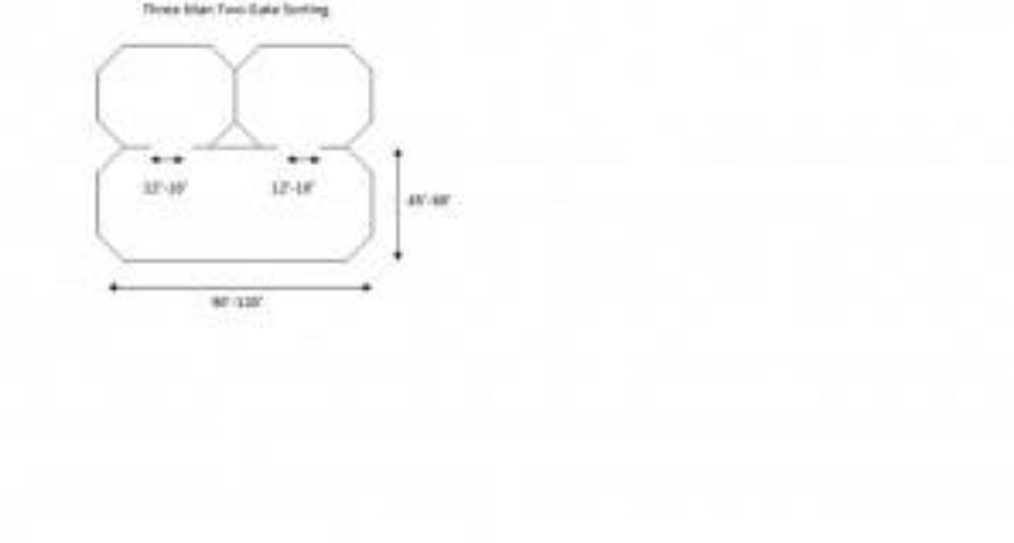
- Pen size approximately 100' × 50' with two 12'–16' gates.
- Ten numbered cattle (0–9) and one blank (11 total).
- Time starts when the judge drops the flag as the first horse crosses. Cattle must be sorted in numerical order through either gate.
- Recommended herd change: no more than 5 runs per herd, including all goes.
- Roughing strictly enforced. Riders are disqualified if they drive cattle into walls without giving room to escape (see Rule 2.2.5).
- Producer has the option to use 2 judges if necessary.
4.4.12 Three-Man One-Gate Sorting
- Pen size 70'–90' with one 14'–18' gate.
- Ten numbered cattle (0–9) and one blank (11 total).
- Time starts when the first horse crosses the line.
- Recommended herd change: no more than 5 runs per herd.
- Roughing strictly enforced for safety (see Rule 2.2.5).
4.4.13 Western Heritage Sorting
This class rewards quiet, controlled cattle handling and attracts riders who prefer precision over speed.
Rules:
- Limited to a trot or walk by the Sorter. Loping after one stride results in a no-time unless defending the gate from a wrong-numbered cow. The Gate rider may lope defensively but cannot lope into the herd to sort.
- Verbal noise to influence cattle is prohibited, except whistling, clucking, hissing, or slapping chaps, which are common practices among cattlemen. Shouting or artificial whistles result in a no-time. Communication with your partner is allowed.
Legend Western Heritage Division All contestants in this division must be 65 or older by December 31 of the current year.
Approved Western Heritage Classes Include:
- WH All Levels
- WH #6 (#3 Cap on Rider)*
- WH #6HC
- WH #10 Beginner Ranch Hand (1 Cap on Sorter)*
- WH #10 Legend *Does not count toward National Points Race.
4.5 Entries and Go Round Rules
4.5.1 Pick and Draw System
Designed to help new contestants find rides and meet others.
- 5-ride limit per class.
- One mandatory draw.
- Contestants may Pick up to 4 and draw 1 or have any combination of picks and draws that add up to the 5 ride limit.
- #11 and #14 Ranch Hand classes may allow up to 9 rides total (4 picks on each side + 1 draw).
4.5.2 Number of Gos
For all Cinch RSNC sanctioned classes with entry fees of $35 or higher, the standard number of go’s applies. If fees are below $35, Producers may choose 1 Go and Top Ten, regardless of team count. The number of go’s must be announced before the class begins, and the draw cannot be altered after posting. (See Table 8.2 in Section VII)
4.5.3 Running Order
All Cinch RSNC classes are progressive — contestants must successfully sort in each go to advance. A 0 head sort is considered a no time. All rounds after the first will run in reverse order of the previous round for the advancing teams until the final round. Finals (Top 10) running orders are determined by draw, either mechanical or physical, at the Producer’s discretion.
4.5.4 Recommended Payout Schedule
See Table 9.4 for Payout Schedule Chart
a) At all RSNC sanctioned events, the percentage of payback is at the Producer’s discretion. All classes will include an additional $3 per ride, per person Sanctioning Fee.
b) Suggested payout split: 7.5% of the purse to the Fast Go in the first go-round after 50 teams have entered, and 92.5% to the average.
c) Fast Go payout structure:
- No Fast Go payout for the first 50 teams.
- Two places paid for 51–100 teams.
- Three places paid for 101+ teams. d) The average will pay one place for every 15 teams or portion thereof (see payout table), up to a total of five places. Additional places beyond five should follow the payout table accordingly.
e) If less than the number of paid teams get a time in the final go the placings will go back to the previous go to get the correct number of paid teams. (See Placings 2.4.1)
4.5.5 Duplicate Teams
Two-member teams may ride together only once per class, except:
- When paired by a Draw, or
- In Ranch Hand classes, where teams may ride together twice if they change designated Sorters. Three-member teams must change one rider each time.
4.6 Draw Out and Replacement Policy
Teams may draw out prior to the final draw for their class without penalty. If notice is not given before the final draw, entry fees are forfeited.
If an individual draws out:
- Their partner may either withdraw or replace the drawn-out contestant with one of equal or lower rating.
- No contestant may use another contestant’s entry fee.
If a replacement occurs due to a doctor’s or vet’s release, the new contestant pays entry fees only—no late fees apply. Once a substitution is made, it is final for that class.
In the event of an emergency involving a contestant, family member, or horse, the Producer may draw the team out and refund the fees. See also Rule 7.4.
Section V – Sanctioning
5.1 Cinch RSNC Sanctioned Sortings
5.1.1 Approval
To be a sanctioned show, the event must be cleared on the Association calendar and approved by Cinch RSNC. Sanctioned sorting may include:
- Western Heritage Sorting
- 1-Man Ranch Hand Sorting
- 2-Man Ranch Sorting
- 2-Man Ranch Hand Sorting
- 3-Man/2-Gate Ranch Sorting
- Open Arena Sorting
5.1.2 World Finals Qualification Approval Deadline
To count as a qualification toward the RSNC World Finals within the final three months of the national season, the show must be requested and approved prior to March 15, unless special sanctioning is granted by the Cinch RSNC office.
5.2 Required Classes
5.2.1 Minimum Class Requirement
A sanctioned event must include at least 5 classes, including:
- All Levels HC or Western Heritage All Levels
- #11 Rookie (2 cap on Sorter) or Beginner
For 2-day events on one of the days (counting as two separate shows)
- A #13 Handicap or above class may replace the All-Levels requirement.
- A #4 class may replace the Rookie/Beginner requirement.
- A maximum of one non-sanctioned class per day may be held under special sanctioning for a specific benefit or cause. A Producer may hold non-sanctioned classes only on a separate day if choosing to split sanctioned vs. non-sanctioned offerings.
5.2.2 Round Robin Approval
A Round Robin may count as one of the five required classes OR a lower-level and upper-level Round Robin held on a separate day may count as a sanctioned event. If entries are limited, notice must be posted on the event flyer at least 5 days before the entry deadline. Cinch RSNC recommends accepting all entries, and if too many entries are received to run as one round robin, split the entries for that class into two separate round robins.
5.2.3 Quick Draw Approval
A Quick Draw may count as one of the five required classes OR a lower-level and upper-level Quick Draw on a separate day may count as a sanctioned event. Quick Draw must include a minimum of 8 draws per rider to count as a sanctioned show.
5.2.4 Approved Western Heritage Classes
- WH All Levels
- WH #6 (#3 Cap on Rider)*
- WH #6HC
- WH #10 Beginner Ranch Hand (1 Cap on Sorter)* *These classes do not count toward the National Western Heritage Points Race.
5.3 Producer Responsibilities
5.3.1 Failure to Comply
Failure to comply with any Cinch RSNC rules may result in forfeiture of future sanctioning for the Event Producer, including events already sanctioned or pending approval.
5.3.2 Special Sanctioning
Special sanctioning may be granted by Cinch RSNC and may include modifications such as higher ride limits, fewer required classes, alternate class numbers, or expanded pick/draw options. Any granted deviations must be advertised in advance of the show.
5.3.3 Liability & Insurance Requirements
Each Event Producer operating a sanctioned show is solely responsible for any and all liability and must hold Cinch RSNC, its officers, and its directors harmless. All sanctioned events must comply with association insurance requirements, and Producers must apply for and receive appropriate insurance prior to each sanctioned event.
5.3.4 Cinch RSNC Bylaws
All sanctioned classes must operate under Cinch RSNC bylaws, rules, and guidelines.
5.3.5 Social Security Numbers
The Event Producer has the right to require any contestant to provide their Social Security number before receiving prize money. Contestants who refuse forfeit their winnings to the Producer.
5.3.6 Liability Release Forms
RSNC and Event Producers may require any contestant, or in the case of a Youth rider, their parent or guardian, to sign a Liability Release form. As members, contestants agree to hold Cinch RSNC and Event Producers harmless for any injury incurred as a result of participation.
5.3.7 Black Ball List
Cinch RSNC will enforce a blacklist of participants who write bad checks, fail to pay entry fees or other required charges at any sanctioned show, or any contestant that is suspended for a rule violation.
5.3.8 Show Credit for Show Staff
Only the individuals listed on the official Cinch RSNC Producer Contract — Producer, Co-Producer, Secretary, Judge, and Announcer — will receive official RSNC show credit for working a sanctioned event.
Show credit includes:
- 1 show credit toward World Finals and State Finals qualifications per show worked.
- 10 rides per show worked applied toward the Cinch Shootout Bonus awarded at the World Finals.
- No other positions or helpers are eligible for show credit.
Section VI – Producer and Event Personnel Guidelines
6.1 Guidelines for Event Producers
6.1.1 Any reputable person who can furnish proof that he or she is capable through ability or experience may act in the capacity of an Event Producer.
6.1.2 Event Producers must submit the required Cinch RSNC Producer Contract pages with requested show dates a minimum of two (2) weeks prior to the first requested date.
6.1.3 Event Producers must have Cinch RSNC Approved Judges for their events. The Event Producer must request that Judge tests be sent to selected individuals so they have adequate time to apply and submit the required documentation/files for RSNC approval a minimum of two (2) weeks prior to the Producer’s first scheduled event.
6.1.4 Event Producers must contact Cinch RSNC Headquarters to request event insurance a minimum of two (2) weeks prior to each scheduled event.
6.1.5 The Event Producer has the authority and responsibility to enforce all rules pertaining to the show. He or she may excuse any horse or exhibitor from the show prior to or during the competition for any infraction of rules or misconduct.
6.1.6 The Event Producer has the authority and responsibility to enforce all ratings and rating rules. Any suggested rating changes will be confirmed by the Cinch RSNC office.
6.1.7 Pay for judges, timekeepers, announcers, and show secretaries is at the Event Producer’s discretion. These positions shall be paid for by the Event Producer.
6.1.8 The Event Producer must be present on the show grounds for the duration of the show. In the event an emergency arises and the Event Producer is unable to fulfill his or her duties, they may appoint an Acting Event Producer in their absence. The Acting Event Producer must also remain on the show grounds for the duration of the show.
The Event Producer shall at all times make every reasonable effort to ensure the comfort of the horses, cattle, exhibitors, spectators, and officials, and is responsible for maintaining clean and orderly conditions throughout the show.
6.1.9 The Event Producer shall receive written complaints from exhibitors, trainers, owners, show participants, and other Cinch RSNC members regarding incidents of cruel, abusive, or inhumane treatment of livestock on show grounds, and shall forward such complaints to Cinch RSNC for possible disciplinary action under the unsportsmanlike conduct rules.
6.1.10 In the event of an emergency involving an injured contestant, the Event Producer has the authority to make an emergency 911 call for assistance.
6.2 Guidelines for Judges
6.2.1 The Event Producer may select any reputable person to apply to become a Cinch RSNC Approved Judge. The selected individual must become familiar with Cinch RSNC rules and submit a written rulebook test with a score of 90% or better to the Cinch RSNC Headquarters Office a minimum of two (2) weeks prior to their first event as an Approved Cinch RSNC Judge. Judges must renew their certification every two years by taking and passing a judge’s test.
6.2.2 The Judge is responsible for enforcing Cinch RSNC rules and class procedures as outlined in the rulebook. The Judge is responsible for checking each herd as it enters the arena for correct head count, proper numbering, number readability, and for watching for lame or crippled cattle.
6.2.3 All Approved Judges will be placed on the Cinch RSNC Approved Judges list on the Cinch RSNC website.
6.2.4 Designation as a Cinch RSNC Approved Judge is a privilege, not a right. It is bestowed by Cinch RSNC to individuals whose expertise and character merit the honor. Conduct and ability must be exemplary.
6.2.5 After accepting a judging commitment, a Judge shall make every reasonable effort to fulfill the assignment and must communicate promptly with show management if they are unable to do so, allowing management adequate time to secure a replacement.
6.2.6 During an approved show, a Judge shall be present to meet responsibilities under Cinch RSNC rules and assist show management with rule compliance, including calling 911 in case of emergency.
6.2.7 All Judges at a Cinch RSNC sanctioned show must wear western attire: a western hat (optional), a long- or short-sleeved western shirt tucked in and buttoned properly, and boots. Tank tops, t-shirts, and ball caps are not allowed.
6.2.8 When a participant makes a request through the Arena Director or other show official for the Judge’s opinion, the Judge is urged to give their opinion courteously and sincerely in the presence of that official.
6.3 Guidelines for Announcers
All Cinch RSNC Announcers must be familiar with Cinch RSNC rules and general guidelines.
6.4 Guidelines for Show Secretaries
6.4.1 The Event Producer may select any reputable person to become a Cinch RSNC Show Secretary. The individual must become familiar with Cinch RSNC rules and software and must successfully run and submit the files from a completed Virtual Show using Cinch RSNC software a minimum of two (2) weeks prior to their first event.
6.4.2 Designation as a Cinch RSNC Show Secretary is a privilege, not a right, and is bestowed on individuals whose expertise and character merit the honor.
6.4.3 The Show Secretary is responsible for the accuracy of entries and show results, including verifying exhibitor eligibility. Results for each class must be posted within one hour of the conclusion of that class.
6.4.4 The Show Secretary must maintain and record all entries and results. Electronic results, sanctioning fees, and membership forms must be submitted to Cinch RSNC within five (5) days of the last day of the show. Failure to comply may result in fines and loss of future sanctioning privileges.
- The Show Secretary shall keep a copy of the results on file for at least one (1) year.
- The Show Secretary and Producer are jointly responsible for all fees collected on behalf of Cinch RSNC.
- Cash payments should be converted to money orders or checks before submission.
- No results will be posted until all required information and fees are received by Cinch RSNC Headquarters.
Section VII – Mandatory Event Guidelines
7.1 Conduct
7.1.1 Each Cinch RSNC member shall follow Cinch RSNC rules at all sanctioned shows.
7.1.2 Any contestant who is guilty of misconduct may be fined from $20 to $250 or be expelled from the contest and/or the Association. Cinch RSNC reserves the right to revoke or refuse membership for proper cause. Misconduct includes, but is not limited to, abusive or foul language toward other individuals in or outside the arena and abuse of livestock.
7.1.3 If a person is fined, the fine will be determined and assessed by the Judges and/or Producer.
7.1.4 Fines must be paid before the contestant rides again or competes in future events.
7.1.5 An approved Judge shall be treated with courtesy, cooperation, and respect. No person shall direct abuse or threatening conduct toward any Judge or a Judge’s family, whether on or off the show grounds.
7.1.6 By virtue of paying an entry fee and/or competing in a Cinch RSNC sanctioned competition, whether or not he or she is a paid Cinch RSNC member, each contestant grants permission to Cinch RSNC to use his or her photographic image for the promotion of the sport of Ranch Sorting.
7.2 General Event Guidelines
7.2.1 There must be at least one (1) sorting Judge approved by Cinch RSNC and compensated by the Event Producer. The announcer may function as a timekeeper. Decisions of the Judges are final. The Cinch RSNC Arena Director will cast any necessary tiebreaker.
7.2.2 All proceeds and records of the show must be submitted to the Cinch RSNC National Office within five (5) days of the last day of the show. For each day late after five (5) days, an Event Producer will be fined $100 per day. This rule is in effect to allow Cinch RSNC to publish results in a timely manner. Any fine must be paid before the Event Producer’s next scheduled show. Failure to do so will subject the Event Producer to loss of future sanctioning.
7.3 Event Cancellation
In the event a show is canceled due to weather or other extenuating circumstances before the final go-round, the last fully completed go-round will determine the winners of the class. The decision to stop the sorting shall be made jointly by the Event Producer and the Judges.
7.4 Substitute Riders
In extreme instances, substitution of a rider after a team has made its original ride may be allowed at the discretion of the Producer for compassionate reasons. The Show Secretary must be notified to ensure that monies are awarded to the appropriate rider in each go.
Substitute riders must:
- Have available rides so as not to exceed the class ride limit.
- Have a rating equal to or lower than the original rider.
- Not cause the team’s combined rating to exceed the class cap.
7.5 Settling cattle
Each herd must be familiarized with both sides of sorting pens before the first team runs on a herd.
Section VIII – Qualifications
8.1 World Finals Qualifications
- First-year members are exempt from the 5-show requirement to compete at the World Finals. However, they must attend 5 shows to be eligible for high-point awards.
- All other contestants must ride at a minimum of 5 shows during the season to be eligible to compete at the World Finals.
- To be eligible for added money at the World Finals, contestants must accumulate 100 rides throughout the season.
- To qualify for Top 10 awards within your division, contestants must:
- Attend 5 shows, and
- Finish in the Top 10 of your state points race.
- Qualifying Show Requirement: For a show to count toward any qualification requirements, a contestant must enter a minimum of 5 times at that event.
8.2 State Finals Qualifications
- Any contestant is eligible to compete at any State Finals, regardless of residency.
- To be eligible for RSNC year-end prizes, a contestant must:
- Enter the state finals show in the Top 20 of their division’s state points race, and
- Ride 5 rides at 5 shows within that state, including the State Finals.
Section IX – Forms, Charts, and Appendices
9.1 Arena Diagrams
9.1.1 Ranch Sorting Pen Diagram
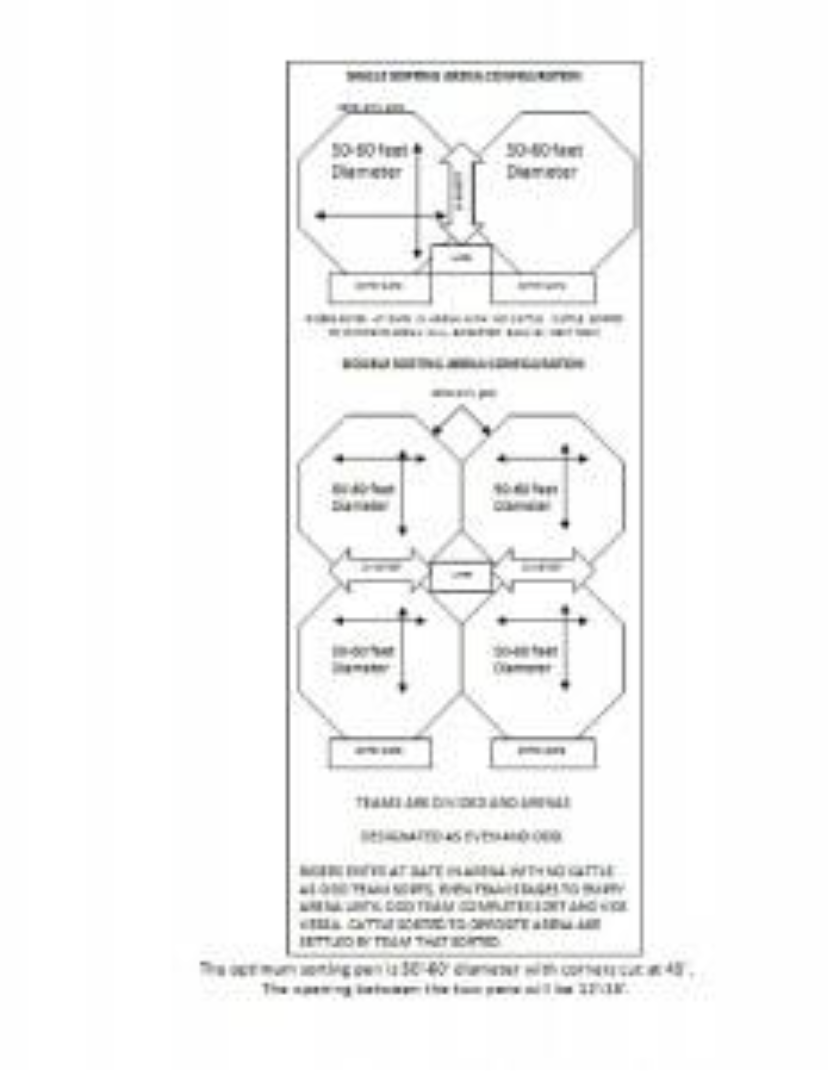
The optimum sorting pen is 50′-60′ diameter with corners cut at 45’. The opening between the two pens will be 12′-16′.
9.1.2 3 Man 2 Gate Pen Diagram
9.1.4 Open Arena Sorting Pen Diagram
9.2 Go Round Rules Table
1st Go | 2nd Go | 3rd Go | Final Go |
|---|---|---|---|
1-50 Teams | 10 Teams | ||
51-100 Teams | 20 Teams | 10 Teams | |
101-150 Teams | 30 Teams | 10 Teams | |
151-200 Teams | 40 Teams | 10 Teams | |
201-250 Teams | 50 Teams | 10 Teams | |
251-300 Teams | 60 Teams | 20 Teams | 10 Teams |
301-350 Teams | 70 Teams | 20 Teams | 10 Teams |
351-400 Teams | 80 Teams | 20 Teams | 10 Teams |
401-450 Teams | 90 Teams | 20 Teams | 10 Teams |
451-500 Teams | 100 Teams | 20 Teams | 10 Teams |
501-550 Teams | 110 Teams | 30 Teams | 10 Teams |
551-600 Teams | 120 Teams | 30 Teams | 10 Teams |
601-650 Teams | 130 Teams | 30 Teams | 10 Teams |
651-700 Teams | 140 Teams | 30 Teams | 10 Teams |
701-750 Teams | 150 Teams | 30 Teams | 10 Teams |
751-800 Teams | 160 Teams | 40 Teams | 10 Teams |
801-850 Teams | 170 Teams | 40 Teams | 10 Teams |
851-900 Teams | 180 Teams | 40 Teams | 10 Teams |
901-950 Teams | 190 Teams | 40 Teams | 10 Teams |
951+ Teams | 200 Teams | 40 Teams | 10 Teams |
9.3 Quick Reference Handicap Chart
Each pair is a rating and the seconds of handicap it carries in that class.
All Levels | #14 | #13 | Rookie | #11 | Beginner | #10 | #6 |
|---|---|---|---|---|---|---|---|
2 +16 | |||||||
3 +15 | 2 +12 | ||||||
4 +14 | 3 +11 | 2 +11 | |||||
5 +13 | 4 +10 | 3 +10 | 2 +9 | 2 +9 | |||
6 +12 | 5 +9 | 4 +9 | 3 +8 | 3 +8 | 2 +8 | 2 +8 | |
7 +11 | 6 +8 | 5 +8 | 4 +7 | 4 +7 | 3 +7 | 3 +7 | 2 +4 |
8 +10 | 7 +7 | 6 +7 | 5 +6 | 5 +6 | 4 +6 | 4 +6 | 3 +3 |
9 +9 | 8 +6 | 7 +6 | 6 +5 | 6 +5 | 5 +5 | 5 +5 | 4 +2 |
10 +8 | 9 +5 | 8 +5 | 7 +4 | 7 +4 | 6 +4 | 6 +4 | 5 +1 |
11 +7 | 10 +4 | 9 +4 | 8 +3 | 8 +3 | 7 +3 | 7 +3 | 6 +0 |
12 +6 | 11 +3 | 10 +3 | 9 +2 | 9 +2 | 8 +2 | 8 +2 | |
13 +5 | 12 +2 | 11 +2 | 10 +1 | 10 +1 | 9 +1 | 9 +1 | |
14 +4 | 13 +1 | 12 +1 | 11 +0 | 11 +0 | 10 +0 | 10 +0 | |
15 +3 | 14 +0 | 13 +0 | |||||
16 +2 | |||||||
17 +1 | |||||||
18 +0 |
9.4 Recommended Payout Schedule
Places | # Teams | Percentage Splits |
|---|---|---|
1 | 1-15 | 100% |
2 | 16-30 | 60%-40% |
3 | 34-45 | 50%-30%-20% |
4 | 46-60 | 40%-30%-20%-10% |
5 | 61-75 | 34%-27%-20%-10%-9% |
6 | 76-100 | 32%-24%-17%-10%-9%-8% |
7 | 101-150 | 28%-22%-17%-10%-9%-8%-6% |
8 | 151-200 | 26%-22%-14%-10%-9%-8%-6%-5% |
9 | 201-250 | 26%-19%-13%-10%-9%-8%-6%-5%-4 |
10 | 251+ | 25%-18%-13%-10%–8.5%-7%-6%-5%-4%-3.5% |
Recommended Payout Schedule
- At all RSNC Sanctioned events the % payback will be the producers’ option. All classes will have an additional $3 per ride per person Sanctioning Fee.
- Suggested split of the purse: 7.5% to the Fast Go in the first go round after 50 teams, with 92.5% to the average.
- In the Fast Go, no places are paid for the 1st 50 teams, 2 places are paid from 51-100 teams, 3 places are paid 101+ teams.
- The average will pay one place for every 15 teams or part thereof (see chart above) up to a total of five places (see chart above for payouts beyond 5 places).
9.5 Points Chart